
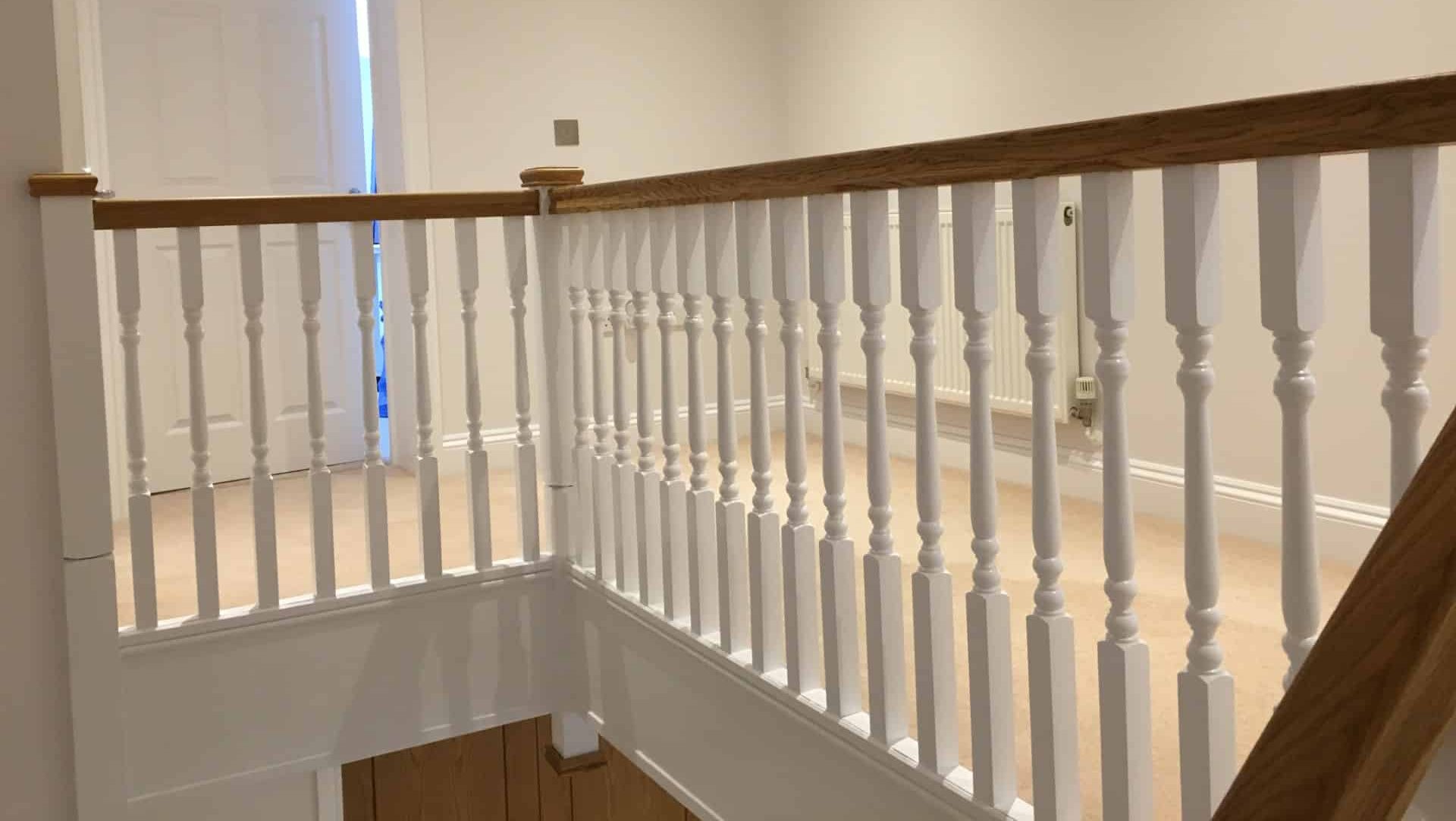


One of the biggest changes I’ve seen in my time as a professional decorator is the switch from oil- to water-based paints for wood and metal work. When I first started, all we used was oil-based, whereas these days I would estimate that 95% of my work is with water-based, maybe even more if I exclude external work.
The benefits of water-based products are clear (non-yellowing, more environmentally friendly, low odour, faster re-coat times, easier clean-up), but so are the downsides; because they don’t flow like oil-based paints, it can be hard to achieve a good finish. Brush marks, drips and sags etc are all common problems.
Thankfully, water-based paints are improving all the time, and we as decorators are getting more used to working with them, and adapting our techniques to accommodate them.
In this blog I’ll try to show you how, with the right tools, preparation and techniques, you can achieve a good finish with water-based satin paint. Feel free to skip ahead and just pick out the bits of information you need.
Understanding Water-Based Satin Paints
What is satin?
Satin is an indication of the sheen level of the paint when dry. Gloss is the shiniest, matt is the least shiny, and satin is roughly in the middle (eggshell, FYI, sits between matt and satin).
Satin is really popular at the moment, I would estimate that 80-90% of the internal woodwork I paint is with water-based satin paint. As well as looking great, it’s a very practical finish; it’s very smooth, so it’s easier to clean than matt or eggshell, but without the high-shine look of gloss, which has fallen out of fashion to some extent.

Why is water-based satin different to oil-based?
Apart from the obvious fact that the two formulations are very different chemically, oil-and water-based paints behave very differently in use. Oil paints take much longer to dry, and over that time they naturally “level out”, so brush marks disappear.
Water-based paints dry quicker and don’t have the same levelling properties, so brush marks remain. Applying the paint more thickly partially solves the problem, but creates other issues, as the paint then runs, drips and sags. So, it’s always going to be harder to achieve a perfect finish with water-based paints. (For more on the differences between oil- and water-based paints, see our separate blog on the subject).

Thorough Prep is Essential for Achieving a Good Finish with Water-Based Satin
It’s pretty hard to achieve a good finish, whatever the surface and whatever type of paint you use, unless you’re thorough with your prep. Start by making sure the surface is clean and free of grease etc by using Zinsser Universal Degreaser & Cleaner – failure to do this at the outset may prevent your paint from adhering correctly to the surface.
Ensure any lumps and bumps are sanded smooth, and any gaps, cracks and holes are filled using decorator’s caulk and a good quality wood filler such as HB42 Ultimate. Give the whole surface a thorough but light sand to provide a “key” – again, this is to help with paint adhesion. Make sure you clean the surface thoroughly again afterwards to remove all dust.
- If you’re painting over anything other than water-based paint, you will probably need a primer to help the paint to adhere properly.
- On bare wood or metal, an appropriate wood or metal primer is needed (e.g. Johnstone’s Trade Joncryl Water-Based Primer, or Bedec Metal Primer)
- For new MDF, use Johnstone’s Trade MDF Primer (see our separate blog on how to paint MDF).
- When painting over old oil-based paint, use a quality adhesion primer. There are loads of good ones around these days – my personal favourites are Crown PX4 and Bedec All Prime.
- If you’re painting over stained or varnished wood, it’s often hard to tell what products have been applied to it in the past, so to be on the safe side I use Zinsser Cover Stain, which not only grips extremely well, it blocks stains like tannins or wood stains.
Tips for Applying Water-Based Satin
In no particular order, these are lessons I’ve learned along the way, on my journey from oil- to water-based paint usage.
Use a good paint and suitable tools
I’ll get into this a little more later on, but tools and paint really do make the world of difference. You’ll achieve a vastly better finish, and the work will be more enjoyable.
Stir the paint well before use
I’ve found that with some water-based satins the solids in the paint can sink to the bottom of the tin, meaning that if you don’t stir it, the paint will be too thin at the start of the job, and too thick at the end, neither of which help you to achieve a great finish.
Decant the paint
Decant a small amount of paint into a kettle or mini roller tray, and work from that – put the lid back on the tin and leave it somewhere out of your way to avoid accidents; nobody wants paint on their carpet!

Have a kettle or small bucket of water nearby
Dip you brush in it before you start, and give the brush a quick rinse in it every hour or so – this helps to stop the paint “clogging” on your brush; when the filaments get stuck together by semi-dried paint, they leave bigger, more noticeable brush marks.
Wipe the surface you’re about to paint with a damp cloth
Do this before you start each section. Apart from removing dust, this can sometimes help the paint to flow better.
Don’t put too much paint on your brush
I know it’s tempting, as you think you can work faster (which is a good thing with water-based paints), but there’s a real risk of sagging, drips and runs.
Keep a wet edge
Work in manageable sections to ensure you keep a wet edge. For larger areas apply the paint with a mini roller and lay off with a brush, working in one direction (with the wood grain ideally).
Don’t mess around with it too much
If you notice a drip, it’s usually ok to go back and sort it quickly while it’s still wet, but otherwise it’s best not to go back over your work, as water-based paints dry quickly and you’ll find your brush drags and catches in the paint, leaving noticeable marks.
Don’t rush drying times
Stick to the manufacturer’s recommended drying and re-coat times.
Abrade before you paint and between coats
Giving the paint a very light sand with fine sandpaper (e.g. 240 grit or higher) to denib between coats will help give you a smooth finish; remove any dust before applying the next coat.
The Best Tools for Achieving a Great Finish with Water-Based Satin
The right tools genuinely make a difference to the quality of the finish you can achieve. You’ll always hear decorators who say that a good painter can get a good finish with any old brush, but why make life difficult for yourself when there are so many good tools around these days?
First of all, if you have a reasonable amount of woodwork to paint, and you have the right equipment, you will always get the best finish by spraying. If spraying is something you’re new to, I highly recommend the “Introduction to Spraying” course run by the Dulux Academy. If you’re familiar with the basics but don’t own the equipment, you can hire a spray machine from your local hire shop.
If you only have a small amount of woodwork to spray, you could use an aerosol. I painted these fiddly louvre doors in next to no time using a Maston One aerosol.

Assuming however that you’re planning to use a good old-fashioned brush and roller, you’re going to want a good quality synthetic brush, and either a microfibre or flock-type mini roller.
Brushes
Personally, I like a 1½” oval angled brush for most woodwork projects; I just like the way the shape of the brush works on the moulded parts of doors, architraves and skirting. But that’s just my preference, we’re all different. Brushes that I have found work really well in water-based satin include:
Axus Décor Silk Cutter – superbly engineered brushes designed for use with modern paints. Click here to see online prices.
ProDec Advance Ice Fusion – another relatively new brush designed for today’s paints – Click here to see online prices.
Corona Archer (or other brush from their “Red-Gold” Series).
Rollers
For larger flat surfaces (like window sills, loft hatches and doors), I like to get paint on quickly and evenly by applying it with a roller, and then lay it off with a brush. Getting paint on quickly is important with water-based paints because they dry so quickly, so using a roller helps with this and so helps cut down on “lap marks” and brush marks. The ones I use the most include:
Axus Décor Pureflow Ultra – I love these, they’re a great little piece of kit. They have a 4mm nap for a smooth finish, and are available in 2”, 4” and 5” sizes. Click here to see online prices.
Two Fussy Blokes microfibre rollers are probably most decorators’ weapon of choice for this type of job. Click here to see online prices.

Best Water-Based Satin Paints
These days, every paint manufacturer has a water-based satin in their range, and with good reason – it’s almost certainly the most popular finish for internal woodwork at the moment. They’re all constantly innovating and improving their products too, to try to overcome some of the perceived issues around brush marks, opacity problems, etc. Which is great – we all want better quality products. Here are a few really good ones that are out there at the moment:
Johnstone’s Trade Aqua Guard
This is the most popular choice with professional decorators. It’s a three-coat system (as most water-based satinwood paints are). It flows well, the finish is lovely, and it’s VERY durable once fully cured.
The only minor drawback with Johnstone’s Trade Aqua Guard is it can run slightly. We find it best to paint an area, then look over it again 10 minutes later and knock any runs out with a dry paintbrush.

Crown Trade Acrylic Satin
This is a new, fully water-based paint that I love! The white is a ‘proper crisp white’, it flows well, and the finish is lovely. The best thing about Crown Trade Acrylic Satin is how easy it is to use. Honestly, my gran could get a good finish with this paint.
The Acrylic gloss is good too, and I’d say it has a sheen level closer to satin than gloss (water-based gloss paints often have a lower sheen level to traditional gloss).

Little Greene Intelligent Satin
The Premium Option is Little Greene Intelligent Satin, which is one of those which has recently been reformulated. Not only does it give a superb finish, it adheres brilliantly to all sorts of surfaces, so you can usually use it without the need for a separate adhesion primer.
Yes, it’s expensive, but if it saves the time and cost of applying a coat of primer, it’s very definitely worth considering. It leaves a nice finish too.
The only downside is you can’t get this product in Brilliant White, but it is available in several ‘off whites’.

Final Thoughts
Water-based paint is no longer “the future”, it’s what the majority of us are already using most of the time. Satin is by far the most popular finish at the moment (although both matt and eggshell seem to be growing in popularity).
So if you’re painting wood- or metalwork, particularly inside, the chances are that you’ll be using water-based satin. As a bit of an “old school” decorator, it took me a while to adapt and get used to it, but I love it now and don’t want to go back. What I’ve shared above in terms of thorough prep, choosing the right tools and paint, and the application hints and tips, are things I’ve learned along my journey from oil- to water-based paint – I hope you find it helpful when you’re trying to achieve a better finish with modern water-based satin paint.











Thanks DF for this informative blog post. I find water based easier to apply on woodwork like doors, windows and skirting, but tricky on stair stringer because of the obstructions caused by the tread and riser. Oil based easily levels off on this, but water based drags and can start looking less even. Any tips on navigating these particular features ?