
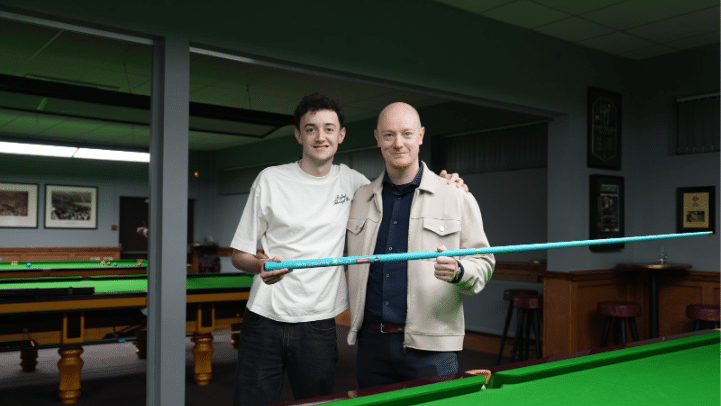


Johnstone’s Paint has partnered with World Snooker Tour (WST) and national mental health charity Mind, to launch Cue the Conversation. The initiative sees snooker halls across the UK use blue coloured cues, to highlight the need to tackle loneliness and help break down taboos around mental health.
The initiative officially kicked off during Mental Health Awareness Week at a special event held at Landywood Snooker Club in Walsall, championed by professional snooker players Chris Wakelin and Liam Pullen. The event marked the start of a wider community rollout, with Wakelin presenting the first of the specially designed blue cues, which will now be distributed to snooker halls across the UK.
Cue the Conversation builds on Johnstone’s Paint’s wider Paint The Whole Picture activity at this year’s Masters in January, which focuses on raising awareness of mental wellbeing challenges faced by people working in the trade. Many decorators and tradespeople spend long hours working alone, moving between sites with limited social interaction, which can contribute to feelings of isolation and loneliness.
Ten specially designed blue snooker cues are being donated to snooker clubs across the UK. Each cue is finished in Jamaican Sea from the Johnstone’s Voice of Colour palette – a calm blue shade selected to evoke a sense of togetherness. The cue acts as a discreet signal: if someone is holding it, they are open to conversation.
For players who might be feeling lonely, struggling, or simply unsure how to start talking, the cue offers a subtle way to reach out. It removes the pressure of having to begin a difficult conversation, encouraging organic, peer‑to‑peer connection in a familiar, relaxed setting.
This week’s launch event featured world number 13, snooker star Chris Wakelin, who spoke openly about his own mental health journey.
Chris Wakelin said: “What really stands out to me about Cue the Conversation is how simple it is. It doesn’t force anyone to open up, but it lets people know the door is open.
“Snooker clubs are places where people already feel at ease, so using those spaces to encourage conversation makes a lot of sense. If holding these cues helps someone feel less alone or gives them the confidence to start a conversation, then it can genuinely make a difference.”
For mental health advice and support, visit Mind: www.mind.org.uk/information-support/helplines/














0 Comments