
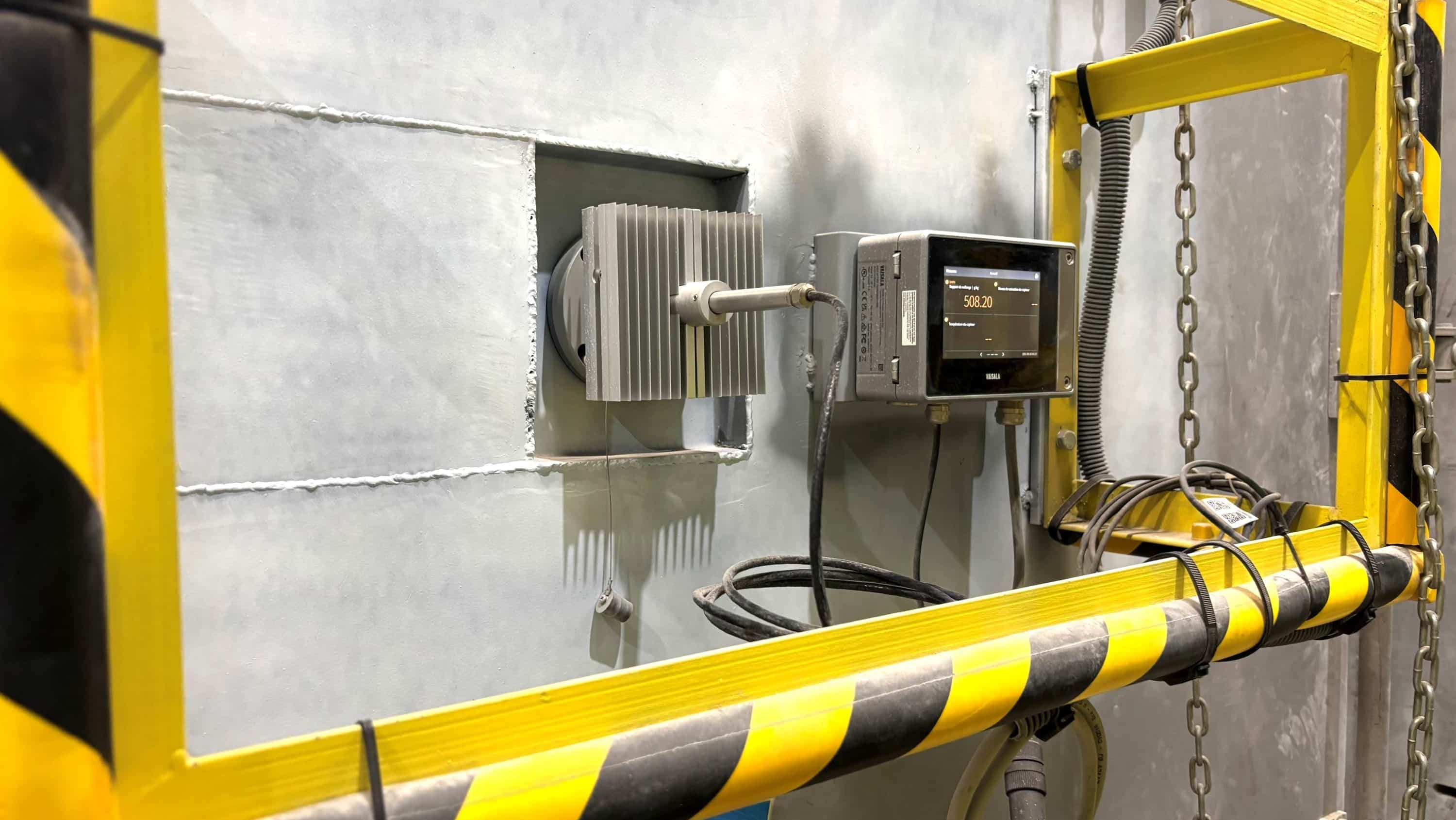




The manufacture of dry wall, also known as plasterboard, relies heavily on precise moisture control, so accurate temperature and humidity measurements during the drying process are essential. However, process conditions change significantly within a short period of time and this can be challenging for many sensors on the market. Looking for ways to enhance the efficiency and sustainability of this process, engineers at Saint-Gobain in France have worked closely with Vaisala to develop monitoring solutions that help optimise plasterboard quality, improve efficiency, save energy and improve sustainability.
Background
Many different industrial processes involve drying operations, and this is frequently the most energy-intensive stage of the process, so accurate monitoring and control of drying can represent significant potential for improvement.
Dry wall has had an enormous effect on the global construction industry since it was first developed in the early 1900s. Lightweight, simple to fit, moisture, fire and mould resistant, and with good insulation properties, plasterboard has become the world’s most commonly used construction material for internal walls and ceilings, after concrete.
Saint-Gobain is the worldwide leader in light and sustainable construction, with around 161,000 employees and over 1100 manufacturing facilities. As a signatory to numerous global sustainability initiatives, Saint-Gobain has committed to reach net-zero emissions by no later than 2050, and the company’s core purpose is to ‘Make the World a Better Home’
The development of Saint-Gobain’s gypsum brands began with the acquisition of the British Plaster Board company in 2005. Today, the company is keenly focused on the improvement of plasterboard manufacturing – improving product quality and lowering carbon footprint.
Saint-Gobain has three controls during the drying process – temperature, air flow and air humidity. However, the accurate management of these controls depends on accurate measurements on the air inside the dryers.
The measurement challenge
Plasterboard is manufactured by pouring gypsum slurry onto carton paper, drying the slurry and adding a second paper layer to form a ‘sandwich’ structure. The gypsum is cured and cut into panels before being passed through drying ovens to obtain the correct moisture content. The whole process can take less than one hour, during which the product can be exposed to temperatures as high as 300°C, depending on the process, and the moisture content of the air varies considerably during the process. “These conditions present a significant challenge for sensors,” explains Jérôme Cantonnet, Drying process Team Leader at Saint-Gobain. “We tried a number of different humidity and temperature sensor suppliers in the early days and found their products to be insufficiently accurate.
Saint-Gobain was one of the pioneers of dew point measurement in plasterboard drying. They chose dew point sensors because they provide an absolute measure of moisture in the air, unlike humidity which changes with temperature. Crucially, there are no similar dew point sensors on the market surviving high temperatures up to +350 °C. Saint-Gobain therefore established a relationship with Vaisala around 2010, working in partnership to adapt Vaisala’s dew point sensors for the specific requirements of their plasterboard application.
For Saint Gobain, it is critically important to be able to assess how reliable measurements are by accessing and monitoring sensor diagnostic data. Vaisala therefore developed a bespoke configuration for their DMP6 dew point, temperature and humidity probe to output these parameters.
Typically, a plasterboard factory needs four DMP6 probes – three to continuously monitor the drying ovens and a fourth for calibration and as a spare.

Advantages of Vaisala’s dew point sensors
The Vaisala DMP6 overcomes many of the problems exhibited by the early trials with humidity sensors from alternative suppliers. This is primarily because of Vaisala’s DRYCAP® technology.
DRYCAP combines a capacitive thin-film polymer sensor with an auto-calibration function. The sensor’s thin-film polymer adsorbs or releases water vapor as the surrounding humidity increases or decreases. This causes a change in capacitance, which is converted into a humidity reading. The capacitive polymer sensor is bonded together with a temperature sensor, and dew point is calculated from the humidity and temperature readings.
The advantages of DRYCAP sensors are condensation resistance, due to the materials in the sensor, and an additional warming function which speeds up sensor drying in a condensing environment. DRYCAP also provides immunity to contamination from particulates, oil vapor and most chemicals. If the sensor does get wet, it dries rapidly and recovers its rapid response time. In low-humidity conditions, the sensor will auto-calibrate to ensure accurate, reliable, stable measurements.
“Vaisala’s DMP6 proved to be a very effective solution,” Jérôme explains. “It is able to maintain accuracy across a wide temperature range, with limited drift and a very low maintenance requirement. It measures directly inside the oven, so no sample line is necessary, and the response time is very quick,” he adds.
Energy efficiency is the major driver for a high level of accuracy in the measurement of moisture inside the drying ovens. For example, Jérôme says: “A small drop in dew point accuracy, say ±2°C, could result in a loss of energy efficiency of up to 10%. This is hugely significant when you consider that our Paris facility has a power consumption of more than 30 MW.”
Heating ovens at plasterboard factories are generally powered by natural gas with electric fans. The implementation of accurate monitoring and control means that the ovens do not have to be run at full capacity, andinstead can be managed to optimize energy efficiency. In addition, in line with its decarbonization goals, Saint-Gobain has already fully electrified two of its plants.
Looking forward
The long-term partnership between Vaisala and Saint-Gobain has resulted in a measurement solution to meet the specific needs of plasterboard manufacture. This has been deployed in Saint Gobain by applying good practice in the utilization of sensors and in the promotion of the energy efficiency objective across the group’s global facilities.
“This is a good example of the ways in which we continuously search for solutions to environmental challenges,” explains Jérôme Cantonnet.
Vaisala’s Juhani Lehto says: “We are delighted to have established this relationship with Saint-Gobain. Not just because it has enabled us to further develop our products, but also because Saint-Gobain and Vaisala share common sustainability objectives. Our core purpose is defined as ‘Taking every measure for the planet’ so it is great to be able to play a role in helping Saint-Gobain on its path to carbon neutrality.”












0 Comments