
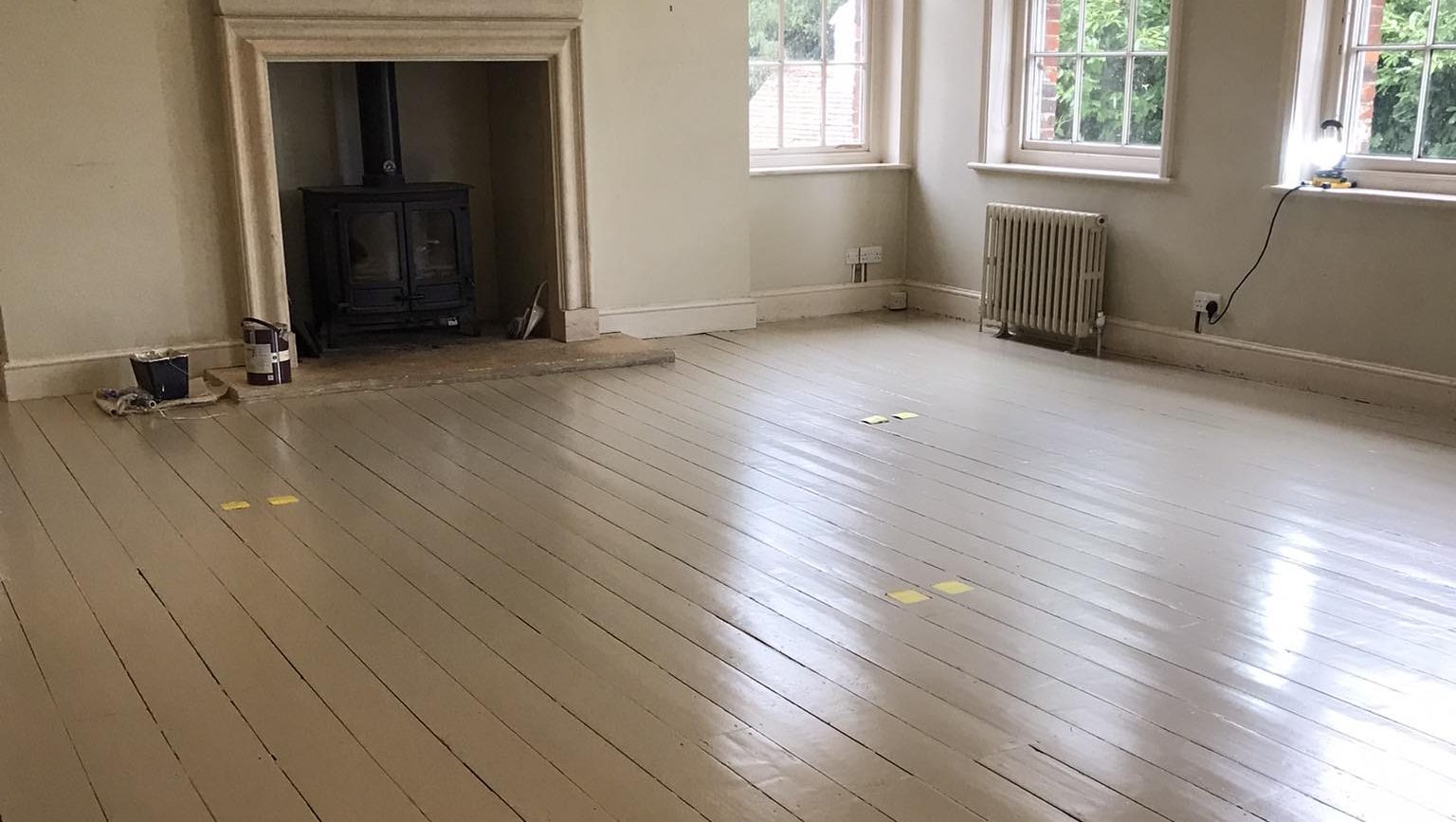


According to a January 2026 article in House Beautiful magazine, painting your floor is one of the biggest trends in UK house maintenance. And I get it, I can see why:
- It’s a relatively low-cost way of refreshing an old floor, and certainly cheaper than replacing it.
- If it’s seen as trendy, that’s a good enough reason for many people!
- Why not? We give our walls, ceiling and other woodwork plenty of love, why not give your floor some TLC and make it a feature of the room, rather than just something you walk on?
If you’re going to seize the day, and feel like having a go at painting your wooden floor (or getting someone in to do it for you), it’s a perfectly achievable goal, but as a professional decorator I would urge you to set realistic expectations:
- Even with a perfectly executed process, the best products in the world and a generous helping of good luck, it’s going to get marked. There are definitely steps that we can take to mitigate this, but your floor is being walked on, so it’s hardly going to be free from wear and tear.
- Preparation, and the right products, are absolutely key to a successful project of this nature. If you try to cut corners, your paint will be looking scuffed, scraped and peeling in no time. We highly recommend therefore that you read this article in conjunction with its sister blog, “The Best Paints for Wooden Floors”.
Is Painting the Floor the Right Option?
Painting any floor is a cost-effective way to help transform a room, and add a huge touch of personality, making the room really unique and “yours”. It can look particularly good in Victorian and other period properties, cottages and so on.
More modern wooden floors made of chipboard, MDF or plywood can be painted too, following pretty much the same process, but to me they somehow look less “personal” and more “industrial” – but that’s just my personal taste, don’t let that stop you!
Similarly, parquet flooring can be painted, but why would you? If it was me, I’d leave it with a more natural look to show off the beauty of the wood. Although I’ve heard of people having a go at painting laminate flooring, I wouldn’t be so keen myself – I think you’d have a hard job getting the paint to adhere properly, and laminate can be relatively affordable to replace anyway, so why not do that instead?
I’d also urge you to think about the room, how it is used, and how much wear and tear it will be subjected to. If you have a 2 year-old spaniel who’s only goal in life is to see how many laps of the living room it can chalk up in a day, then I’d probably not bother painting the floor, because it will get trashed (speaking from personal experience of a close family member!).
But rooms where wear and tear is less likely (bedrooms, dining rooms, studies, for example) are perfect. If your house is home to teenagers who spend hours in the shower, then your bathroom may get too damp, but if not, then bathrooms can look great with painted floorboards, especially if you apply a coat of varnish after.
painting to help protect the floor (more on this later). If your floorboards are old and badly damaged, then sadly adding a coat of paint isn’t going to be enough to make them look good, and in fact sometimes a coat of paint just highlights the imperfections; you might be better off spending the money getting the floorboards repaired first.

Tools and Materials You Will Need for Painting Floorboards
- Hammer and Nail Punch
- Nails/screws
- Bucket of warm water, detergent, mop (or cloth)
- Wood filler
- Sanding equipment (exactly what may depend on the size of the floor)
- PPE – dust mask, ear protection
- Vacuum
- Masking tape
- Paint Brush, Roller
- Primer (depending on the nature of the floor and the paint you choose)
- Floor paint
- Sealing coat or varnish
How to Paint Floorboards
Prepare the floor
Preparation is absolutely key to success in this type of project. The following steps should help you to prep your floor like a pro:
- Clear the room – remove as much furniture as possible. Obviously, if there is carpet, it needs to be removed, along with any gripper rods and staples.
- Secure any loose floorboards, nailing or screwing them into the joists .
- Using a nail punch, make sure that all nails are punched down below the surface – if you don’t do this step, the nail heads will ruin your sandpaper when you get to the sanding stage, and will also be really visible after you’ve painted.
- Give the floor a thorough clean – the less dirt and grime on the surface, the better your paint will adhere.
- Check the floor thoroughly for gaps, chips and cracks, and fill these using a good quality wood filler like Toupret Wood Repair Filler – you can leave the filler a little bit “proud” of the wood, as you’re going to sand the whole surface smooth next anyway .
- Sand the floor thoroughly. What you use will depend on the size of the floor – for large floors I would consider hiring in a floor sander, whereas for smaller floors you can probably manage with a hand sander, ideally a dustless sanding set-up. Whatever you choose to use, make sure you wear a mask (and ear protection) when sanding, because it will produce a lot of dust (and noise). The floor doesn’t have to be perfect, but the smoother you can get it, the smoother the end result.
- Vacuum up all the dust. It’s probably not a bad idea to then wait an hour and vacuum again, because dust in the atmosphere will continue to settle.
- If you are concerned about the possibility of accidentally getting paint on the skirting boards and/or radiator pipes, mask these up carefully with tape.

Prime
whether or not you need a primer will depend on the type of flooring and the paint you choose – some paints specifically state that they don’t need a separate primer.
Choose a primer that is suitable for the type of floor you are painting – we cover specific recommendations for each type of primer in our blog “The best paints for wooden floors”. Apply the primer working in manageable sections, cutting in around the edge with your brush and rolling the main surface of the floor, working with the grain. And start in the furthest corner from the door, finishing in the doorway – you don’t want to paint yourself into a corner!
Allow to dry
Leave the primer to dry thoroughly (check the tin or the manufacturer’s website and follow their guidance on when the primer can be painted over).
Apply your top coats
(Two coats should usually suffice). Follow the same advice as for applying the primer – work towards the door (to give yourself an exit route), work in manageable sections, cut in around the edge and then roll with the grain.
Again, follow the manufacturer’s instructions about drying and re-coat times. For a super smooth finish, sand lightly between coats.
Seal if needed
For added protection, you can apply a couple of coats of clear varnish. There are some really good, hard-wearing, water-based clear-coats available these days which won’t discolour over time, so all you’ll see is the colour of your chosen paint.
Leave everything to cure
It’s probably a sensible idea not to drag heavy furniture across your newly painted floor, or doing anything else likely to cause wear and tear, for at least seven days after you’ve finished painting. Although the paint will feel dry to the touch, some paints take a long time to fully “cure” and reach their optimum hardness.

Creative Ideas for Painting Floorboards
You can have a lot of fun with a project like this. Yes, you could go for one colour for the whole floor; nothing wrong with that, it can look amazing. Or you could use different colours to create zones in a larger room or open plan space. Create squares, diamonds or stripes using masking tape, so your wooden floors almost look like tiles.
If you’re colour drenching your room, why not include the floor in the colour scheme? Or paint everything else one colour, and make the floor your “feature wall”? Or, paint the floor all one colour, and then stencil around the edge in a contrasting colour. The possibilities are endless, and if you’ve got the sort of property where you can have a bit of fun and add some personality, then why not?
Final Thoughts
If we believe what they tell us, painted floorboards are going to be all the rage in the next few years. If you follow the above process, and use good quality products, you should be able to paint your floorboards without any problems, and create something really unique and stunning that will last.
Just be realistic with your expectations – a floor gets a lot of wear and tear, so sooner or later it will get marked (sooner in high traffic areas). And have some fun with it – getting a bit creative can be both enjoyable and rewarding, leaving you with a truly unique and stunning floor.













0 Comments