


I could be wrong in this, but my impression is that eggshell paints are something that professional decorators like me understand, use and love, whereas the “man in the street” is either completely unaware of them, or doesn’t understand what they’re used for.
In a sense I can see why it’s a bit confusing; you use satin or gloss on wood- and metal-work, and matt or silk on walls or ceilings. But with eggshell, there are some you use on woodwork, some you use on walls, and some that will do both! So where do you start trying to explain?!
Let’s start with why eggshell paints are different from gloss, satin, silk or matt. It’s mostly about the sheen level. Eggshell is a bit shinier than matt, but nothing like as shiny as silk, satin or gloss. So, it gives a soft, slightly shiny look if you shine light directly on it, but not the “high glare” that your walls would have if you used silk paint, for example.
In this blog, we’re going to take a look at the pros and cons of using eggshell paint on walls, have a think about which rooms or situations eggshell would work particularly well in, and then get into some specific recommendations on the best eggshell paints for walls based on my own experience as a professional decorator.
We won’t be going into any detail on eggshell paints which are designed specifically for use on wood – these are covered in more detail in the companion blog “The Best Eggshell Paints for Woodwork”.
If you just want the product recommendations, feel free to skip ahead.

What Is Eggshell Paint?
Eggshell is a low-sheen finish. If you imagine a scale from 0 – 100%, gloss paints are typically around 80% sheen level, and matts are generally below 10%. Satin finish, which is really popular on woodwork at the moment, is somewhere between 20-40%, and eggshell is around 10-25% (usually 15-20%).
So, there is a small overlap with satin, but that’s not really an issue when we’re thinking about walls, because satin is used on wood- and metal-work, not really on walls.
So eggshell is a low-sheen paint, meaning it has a slight reflectivity to it if the light catches it, but you wouldn’t describe it as really shiny. This slightly shinier surface makes it easier to wipe or clean than most matt paints, without going all the way to ultra-shiny silk. This low sheen finish has really gained popularity in recent years, both for walls and woodwork too.
There are two types of eggshell paint – oil- (or solvent-) based, and water-based.
Personally, I wouldn’t use oil-based paints on walls. I mean, it can be done, and with the right prep and priming etc, I’m sure it’s very durable. But it will take much longer to dry, give off a lot of unpleasant fumes and VOCs, be prone to yellowing (if you’re using white), and be harder to paint over in the future.
Water-based, or acrylic eggshells are ideal for walls; the oil-based ones are really designed for use on wood- and metalwork. The confusion then comes because many modern water-based eggshells can also be used on woodwork, but let’s move on!
Pros and Cons of Using Eggshell Paint on Walls
Pros
- Durability – eggshell paints are usually hard-wearing, resistant to marks and easy to wipe clean, meaning that they’re ideal for certain rooms or situations where the walls are likely to be marked, and meaning the walls will stay looking new for longer
- Aesthetic appeal – as I mentioned, the subtle sheen of eggshell has really grown in popularity recently
- Some (not all – I’ll come back to this later) are also more resistant to steam, condensation and mould, making them ideal for bathrooms and kitchens
Cons
- Not everyone likes even the subtle sheen of eggshell; there are lots of people who want matt on their walls, and the lower-sheen matt the better
- You do need to be a bit careful with your application in light-critical situations; if your roller or brush technique is a bit “random”, the light will pick up roller- and brush-marks in the paint once it’s dried.
Rooms Where Eggshell Paint is Ideal for Walls
Obviously, if the subtle sheen of eggshell is your thing, then there’s nothing stopping you using it wherever and whenever you want to. It’s an extremely versatile paint, and if you choose one that’s designed for use on wood and metal as well as walls, it’s a great choice for colour drenching projects. The situations where I use eggshell paint on walls most often would include the following:
- Kitchens and bathrooms, especially if you choose one of the mould-resistant ones
- High traffic areas where the walls are likely to be marked or require regular cleaning, e.g. kitchens (again!), hallways, public buildings (for example, I paint all the walls in my local village hall using acrylic eggshell)
- Colour drenching projects and/or media walls, because of the versatility of certain brands, being suitable for use on walls, woodwork, properly primed MDF and metal, etc

The Best Eggshell Paints for Walls
So here we go with some recommendations of eggshell paints for walls, based on my experience of using the products in my role as a professional decorator. In each case, I’ll give you a couple of options to choose from.
Best Eggshell for Walls in Kitchens and Bathrooms
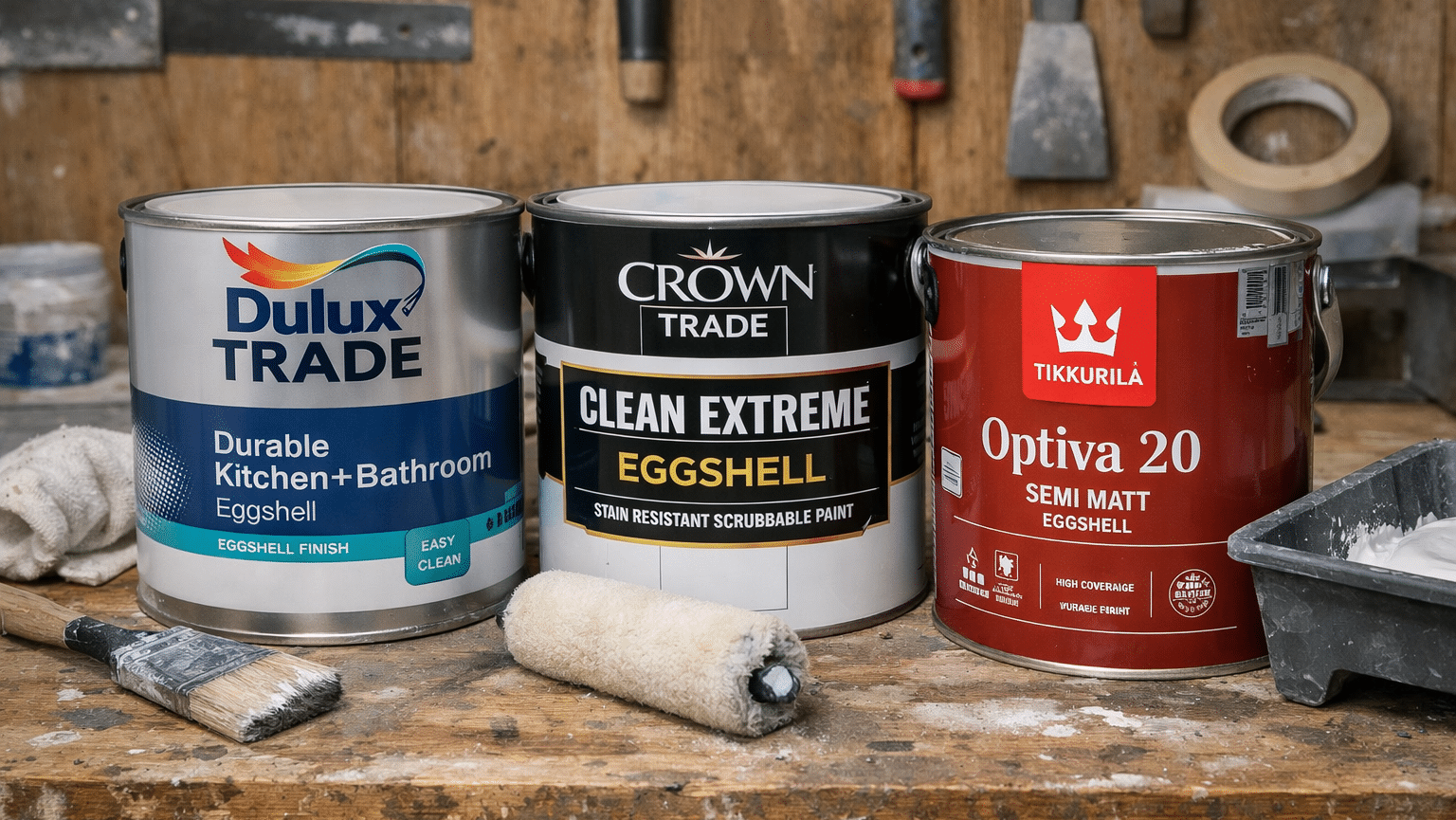
Having said that these recommendations are based on my experience of using the products, my first recommendation isn’t! Dulux Trade have just launched a brand-new product, “Durable Kitchen & Bathroom Eggshell”, specifically for this type of situation. Although it’s so new that I haven’t had a chance to try it yet myself, the claims they make are impressive, and I’m looking forward to giving it a go:
- Mould resistant
- Resistant to the impact of condensation (great in bathrooms!)
- Perfect low sheen finish
- Durable – both stain resistant and scrubbable (great in kitchens!)
- Available in Dulux’s huge range of colours.

My second recommendation: I’ve said it before elsewhere, but this one product solves multitudes of problems that paints have to deal with in bathrooms. Crown Trade Clean Extreme Mould-Inhibiting Acrylic Eggshell is a bit of a mouthful, but it’s worth the effort!
It’s not ridiculously expensive, it’s hard-wearing, resistant to steam and condensation, and stops mould from coming back (assuming that the mould has been properly treated and dealt with in the first place).
I’ve been in a number of situations (swimming pool changing rooms as well a bathrooms) where the previous paint was marked by condensation streaming down the walls (“leaching”); this product seems immune to that problem too (even with teenagers taking forever in the shower!). It’s great, I love it!

Best Eggshell for Walls High Traffic Areas
Tikkurila Optiva 20 is a bit of an underrated product in my opinion. Its cousins Optiva 3 and Optiva 5 seem to get a lot of love from decorators (deservedly so), but Optiva 20 seems to miss out (the “20” represents the sheen level based on the scale I mentioned earlier).
It’s a really good, hard-wearing, stain-resistant eggshell, ideal for high traffic areas. Little known fact: it’s approved by London Underground for use in “sub-surface locations and is ideal for high traffic areas where a stain resistant washable finish is required”.
Best Eggshell for Colour Drenching Projects
Little Greene Intelligent Eggshell is a gem of a paint. The quality is superb, both in terms of the depth of colour, but also the ease of application – it’s almost harder to get a bad finish using this than a good one!
It goes straight on to many surfaces without the need for a separate primer, but not everything, so it’s best to check the website for more detailed information. But the fact that you can use it to paint every surface in the room means that your colour drenching will look completely uniform, and you get to choose from all those ultra-desirable Little Greene colours!

FAQs
Are there any situations where you wouldn’t use eggshell paint?
If the walls are particularly uneven, you will find that the extra sheen of an eggshell compared to a matt finish will highlight the lumps and bumps more. In that sort of situation, I’d personally lean more towards a durable matt.
Is eggshell paint durable?
Absolutely. Particularly if you use the products listed above. I have read a lot of information online about it only being suitable in in “low-medium traffic areas”. I disagree. I’ve had no problems with using it in hall/stairs/landings in rental properties, swimming pool changing rooms, kitchens and bathrooms – as long as you choose the right one for the right situation, you shouldn’t have any issues.
Is eggshell paint cleanable?
Again, the answer is definitely yes. Many of the above recommendations have a “Class 1 Scrub Rating”, meaning that they will stand up to repeated vigorous cleaning.
Can you use the same eggshell paint on walls and woodwork?
It depends on the brand you have chosen, but in many cases the answer is yes, meaning that colour drenching projects can look truly uniform.














0 Comments